

Keyword plus meaning
Built-in BM25 full-text search fuses with dense vectors in one hybrid search, so one vector store for RAG retrieves exact IDs and paraphrased questions alike.
Milvus is an open-source vector database for RAG: keyword, grep-style and semantic search, tenant filters, in-database reranking and disk indexes in one Apache-2.0 package, from a laptop to billions of chunks.
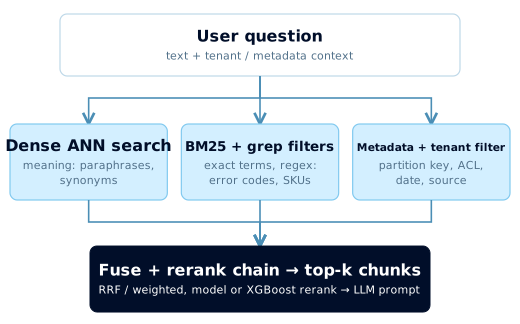
Built-in BM25 full-text search fuses with dense vectors in one hybrid search, so one vector store for RAG retrieves exact IDs and paraphrased questions alike.
Filter expressions (==, in, ranges and JSON paths) run with vector search in one request. Include the correct tenant filter on every request when sharing a collection through a partition key.
Upsert replaces chunks by primary key, deletes remove them, and per-request consistency levels decide how fresh each read must be. No second index to keep in sync.
Disk-based indexes, mmap and tiered storage keep most of a large knowledge base on SSD or object storage instead of RAM.
RAG questions mix meaning with exact strings: error codes, SKUs, clause numbers. Hybrid search for RAG runs dense and BM25 retrieval in one hybrid_search request, and pattern filters narrow both routes.
Since Milvus 3.0, a Function Chain runs an ordered rerank pipeline inside the search request, per segment, per query node and after the global merge, with no client-side requery round trip.
Train an XGBoost ranking model offline on relevance or click labels, register it with Milvus, and let a Function Chain score recalled chunks.
Not every chunk needs to live in memory: HNSW for the hot set, disk and quantized indexes for the rest. Pick the footprint for your latency budget.
| What to check | Why it matters for RAG | Milvus |
|---|---|---|
| Hybrid search (keyword + vector) | Error codes, SKUs and clause numbers miss with embeddings alone | BM25 + dense hybrid_search; regex, LIKE, TEXT_MATCH filters |
| Metadata filtering and multi-tenancy | Each user must see only their documents, at query time | Filter expressions inside ANN; partition key for millions of tenants |
| Reranking | Top-k order decides what the LLM reads | RRF / weighted rankers, model rankers, Function Chain, XGBoost scoring |
| Freshness | Stale chunks produce confident wrong answers | Upsert, delete, consistency levels |
| Scale, cost, managed vs self-hosted | Pilots start small; production reaches billions of chunks | Milvus Lite → Standalone → Distributed, or Zilliz Cloud; DiskANN, mmap, tiered storage |
Store chunks with a tenant field, then retrieve the top matches for one customer and pass them to your LLM.
# pip install -U "pymilvus[milvus-lite]"
from pymilvus import MilvusClient

client = MilvusClient("rag_demo.db")  # same code against http://localhost:19530 or Zilliz Cloud
client.create_collection(collection_name="chunks", dimension=768)

# embed() is your embedding model (768 dimensions here)
client.insert(collection_name="chunks", data=[
    {"id": 1, "vector": embed("Rotate API keys under Settings > Security."), "tenant": "acme",
     "text": "Rotate API keys under Settings > Security."},
])

hits = client.search(
    collection_name="chunks",
    data=[embed("How do I rotate API keys?")],
    filter='tenant == "acme"',          # retrieve only this customer's documents
    limit=5,
    output_fields=["text"],
)
context = "\n\n".join(h["entity"]["text"] for h in hits[0])  # put into your LLM prompt
embed() is your embedding model. For BM25 + dense hybrid retrieval and regex filters, see the hybrid search and pattern matching guides.
One that covers retrieval end to end: keyword plus semantic search, tenant filters, reranking, storage that fits the corpus. Milvus ships all four, open source, one API from Lite to Distributed.
pgvector fits when the corpus is small and already lives in Postgres. A dedicated vector database for RAG pays off when you need hybrid search, filtered search at scale, tenant isolation and disk indexes; Milvus Lite keeps the start just as light.
Not for retrieval. Milvus runs BM25 natively, adds regex, LIKE and TEXT_MATCH filters, and hybrid_search fuses keyword and dense results in one request.
Chunking stays in your loader (LangChain, LlamaIndex, Dify). Embeddings can move into the database: Embedding Functions (Milvus 2.6+) call OpenAI, Cohere, Voyage AI, Gemini and others on insert and at query time, so you store text and search with text.
Yes. In Milvus 3.0+, a Function Chain can score candidates with your XGBoost model or call a hosted reranker inside the search request. Measure recall@k and NDCG on labeled queries before and after.
Yes. pip install Milvus Lite for local RAG, then use the official LangChain, LlamaIndex, Haystack or Dify integrations; the docs also include a Graph RAG tutorial for multi-hop questions. The same code later targets a cluster or Zilliz Cloud.